
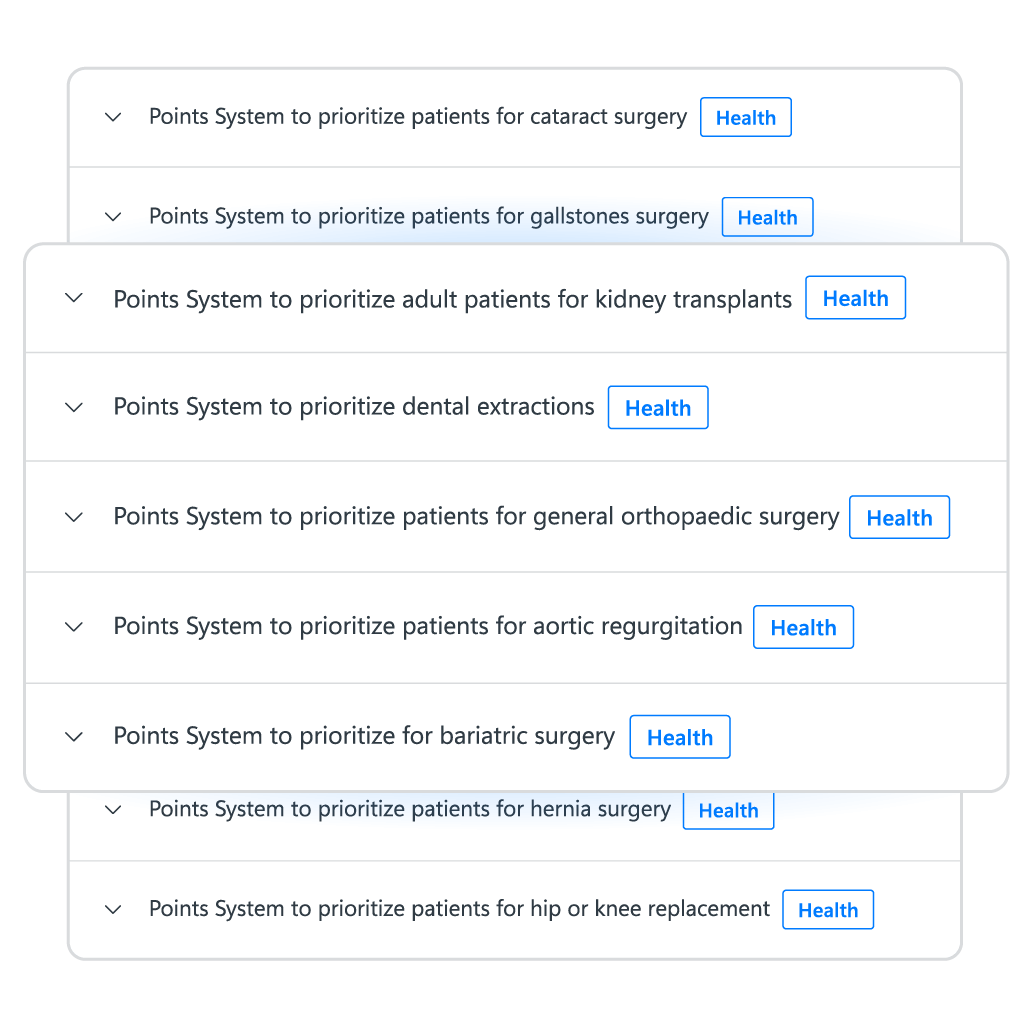
Prioritising patients for surgery.
Historically, in New Zealand and most countries internationally demand for elective health services has exceeded their immediate availability.
Prioritising patients, usually via waiting lists (or ‘booking systems’), is therefore inevitable.
Prior to their overhaul in 1998, NZ’s waiting lists were described as “a diverse mix of patient cases – placed and kept on the list for a number of different reasons, and with no agreed criteria for admission to the list.” (Fraser, Alley & Morris 1993).
According to one cardiologist: “Manipulation by referring doctors, friends in high places, MP letters, or just persistent nagging, and just slight exaggeration of symptoms, is rampant, and the poor benign patient simply sits on the list and is leap frogged." (Hadorn & Holmes 1997).
Patient access was also often inconsistent across regions and specialties.
In an attempt to remedy these problems, ‘Clinical Priority Assessment Criteria’ (CPAC), often implemented as points systems, were introduced nationwide in 1998.
Not long after being introduced, however, several of NZ’s points systems were criticised for being essentially invalid and resulting in significant numbers of patients being mistakenly denied treatment (sometimes with fatal consequences).
Since 2004, using 1000Minds software, the Ministry of Health has led several projects to create and validate new points systems – with the goal of more equitable access to elective services and improved patient outcomes overall.
This was first for coronary artery bypass graft (CABG) surgery, in collaboration with the NZ Region of the Cardiac Society of Australia & NZ (CSANZ). A group of CSANZ cardiologists and cardiac surgeons in different locations throughout NZ used 1000Minds software via the Internet and teleconferences to create points systems for prioritising patients for CABG surgery.
The validity of the new points systems was established by examining the face validity of the relative importance of the criteria implied by the point values and by comparing the ranking of patient case descriptions (‘vignettes’) from the points systems with clinicians’ consensus intuitive rankings (effectively, the ‘gold standard’ here).
In addition, a survey of the participating clinicians revealed high levels of ‘user’ satisfaction with the 1000Minds method/software.
The CABG points systems have been formally accepted by CSANZ and are in use throughout NZ.
Other professional bodies, also supported by the Ministry of Health, have also used 1000Minds for prioritising patients for: hip and knee replacements, vascular surgery, cataract surgery, plastic surgery, and gynaecological, sterilisation and infertility treatments respectively.
Based on this body of work, 1000Minds received several national and international innovation
awards. (More information is available from
article.)
As well as in NZ, 1000Minds is currently being used in the public health systems of Canada’s western provinces, and for prioritising social services, including health care, for ‘people in need’ in the UK.
Other possible health uses of 1000Minds include: advanced planning for disasters and pandemics (e.g. allocating Tamiflu), health technology assessments (currently being trialled by PHARMAC), strategic planning, and assessing students for admission (e.g. to medical schools) and health care professionals for jobs (e.g. junior doctors for hospital posts).
References
G Fraser, P Alley & R Morris (1993) Waiting Lists & Waiting Times: Their Nature & Management, National Advisory Committee on Core Health & Disability Support Services.
D Hadorn & A Holmes (1997) The New Zealand priority criteria project. Part 2: Coronary artery bypass graft surgery, British Medical Journal 314, 135-8.