
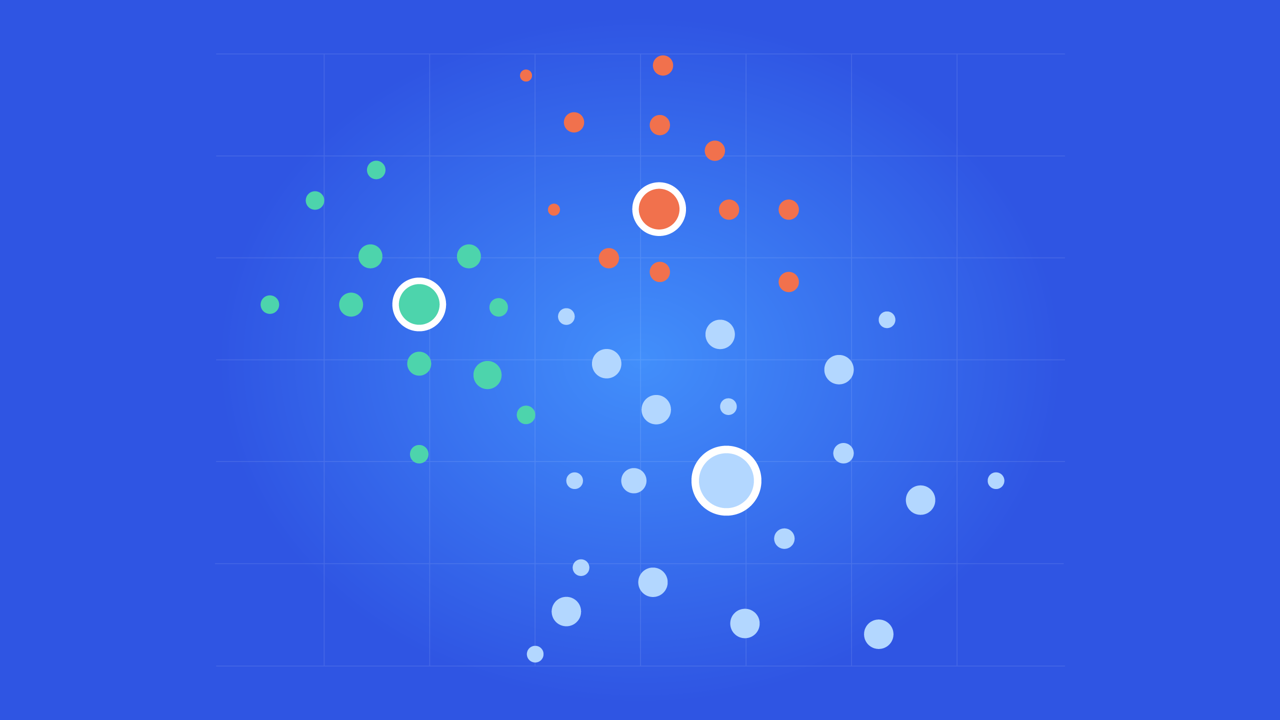
1000minds conjoint analysis software now includes cluster analysis, helping you identify groups of survey participants with similar preferences.
Conjoint analysis on its own is powerful because it reveals what people value. It shows, for example, how much participants care about price, performance, brand, convenience, sustainability or other product features. However, the overall average result across all your participants can hide the most interesting result of all: your participants may not be one market with a common set of preferences.
Instead, there may be distinct groups or “clusters” – and hence targetable market segments in your marketing strategy. One cluster might be price sensitive. Another might value premium features. A third might care most about convenience or reliability. If those clusters exist, treating everyone as an average customer can lead to the wrong conclusions.
1000minds’ cluster analysis helps you find out whether your survey contains these preference-based clusters, understand what distinguishes them and, ultimately, make better decisions.
Find clusters based on what people value
1000minds clusters participants according to their preferences, rather than their age, income, region or other directly observable socio-demographic characteristics.
Cluster analysis uses each participant’s utilities from the conjoint survey and groups participants whose preference profiles are similar into group (“clusters”). Socio-demographics and other survey questions can then be used to look for associations between these preference clusters and participants’ characteristics.
Thus, market segmentation can be more directly actionable as the clusters are based on what people actually care about, which is usually what matters most for product design, pricing and positioning, and better targeted, which focuses marketing strategy.

See the people behind the clusters
1000minds uses k-medoids clustering, specifically the PAM algorithm. One practical advantage is that each cluster is represented by a real participant, called its “medoid” or archetype, rather than by a purely statistical average.
That means every cluster has a genuine exemplar you can inspect. You can see the cluster’s overall preference profile, compare it with the average across all participants, and examine the archetype whose preferences best represent that cluster.
This approach makes the analysis easier to interpret and communicate: a cluster is not just an abstract array of dots on a chart; instead, it’s a group of participants with a recognizable, distinct pattern of preferences.
Judge whether the clusters are real
Cluster analysis will always manage to find clusters if you ask it to. The important question is whether the clusters are meaningful.
1000minds is designed around fully supporting that judgment. It precomputes several possible numbers of clusters, shows the “silhouette” score for each, and gives you visual tools for comparing them. If the clusters make sense to you, you can name and save them. If they do not, that’s useful too: it suggests your participants’ preferences vary gradually rather than falling into distinct groups (which is good to know as well!).

Turn clusters into actionable insights
Once saved, clusters are available throughout your 1000minds results. You can filter results by cluster, include cluster membership in exports, and analyze how each cluster responds across your survey outputs.
For conjoint analysis, this is especially powerful when used alongside 1000minds’ market simulator. Instead of only simulating outcomes for the full sample, you can examine how different clusters respond to alternative product configurations, pricing changes or competitive scenarios.
That analysis can reveal insights that the average result misses. A product concept may look only moderately attractive overall but, in contrast, perform strongly for one market segment. A price increase may be acceptable for some participants and repellant for others. A new feature may matter deeply to a niche group but hardly at all to the wider market.
Better market segmentation from better individual-level utilities
1000minds’ cluster analysis is built on one of the platform’s core strengths: capturing preferences at the individual level (thanks to the PAPRIKA method).
Each participant’s utilities are estimated from their own trade-offs, so the clustering is based on the differences between participants’ preference profiles. That matters because clustering depends on preserving variation between people, not smoothing it away.
1000minds lets you choose what to cluster on and what “distance measures” to apply, and provides practical checks to help you decide whether the clusters are worth taking seriously.
Most importantly, 1000minds keeps the analysis transparent. You can see the profiles, inspect the archetypes, compare possible numbers of clusters, and export the underlying data for further analysis.
Discover how preferences vary
Conjoint analysis tells you what people value. Cluster analysis shows you how those preferences vary. With 1000minds’ new cluster analysis feature, you can identify preference-based clusters, understand what distinguishes them, and use those insights throughout your results.
If clear clusters emerge, you can use them to interpret your results more richly, tailor product or policy insights to different market segments or population groups, and explore how they respond in the rest of your analysis. If clusters do not emerge, that’s useful to know too.
Either way, cluster analysis gives you a clearer view of the diversity of people’s preferences in your survey data.
Try cluster analysis in 1000minds today by signing up for a free trial or book a demo with our friendly team.
Share this post on:
